
-
Publish Your Research/Review Articles in our High Quality Journal for just USD $99*+Taxes( *T&C Apply)
Offer Ends On
Publish Your Research/Review Articles in our High Quality Journal for just USD $99*+Taxes( *T&C Apply)
Offer Ends On
Arthur J. O’Connor*
Corresponding Author: Arthur J. O’Connor, Doctor of Professional Studies, Distinguished Lecturer/Academic Director. ORCID: 0000-0003-4367-0066, Affiliation: MS in Generative AI, MS in Data Science, and BS in Information Science degree programs,
Received: April 08, 2026 ; Revised: April 12, 2026 ; Accepted: April 14, 2026 ; Available Online: April 16, 2026
Citation:
Copyrights:
Views & Citations
Likes & Shares
This econometric study examines the early impact of generative artificial intelligence (AI) adoption on workplace structures and employment dynamics in the United States during the critical period from 2022 to 2025. By integrating multiple large-scale data sources—including the Anthropoid Economic Index capturing approximately one million AI usage interactions, the U.S. Census Bureau Business Trends and Outlook Survey tracking over 1.2 million businesses, comprehensive Federal Reserve Bank regional surveys, and detailed labor market analytics from multiple providers—this research establishes statistically significant relationships between organizational AI adoption and fundamental changes in employment patterns, occupational structures, and compensation dynamics. The analysis employs rigorous econometric methods including difference-in-differences estimation and propensity score matching to control for confounding variables across multiple dimensions: industry classification (NAICS 2-digit codes), firm size categories, geographic location, occupation-level characteristics (educational requirements, experience thresholds), and macroeconomic conditions (GDP growth rates, interest rate environments). After accounting for these factors, the study identifies three interconnected propositions describing how AI adoption is fundamentally restructuring knowledge work.
Keywords: Generative Artificial Intelligence, Organizational Structure, Middle Management, Labor Market, Wage Polarization, Knowledge Work Automation, J01: Labor Economics
INTRODUCTION
The Emergence of Generative AI as a Transformative Technology
As organizations across sectors begin implementing generative artificial intelligence systems into their core operational processes, and as public discourse intensifies regarding AI's potential impact on employment structures and societal organization, the imperative for empirical evidence on actual workplace effects becomes critical. This study addresses that need by providing systematic analysis of how this powerful yet rapidly evolving class of technologies has already transformed workplace hierarchies, job roles, and pay scales during the initial adoption period spanning late 2022 into 2025.
The emergence of large language models (LLMs) and related generative AI capabilities represents a potential inflection point in the automation of knowledge work that may prove as consequential as the mechanization of manufacturing during the early 20th century (Brynjolfsson et al., 2023; Eloundou et al., 2023). Unlike previous waves of technological change that primarily affected manual labor and routine cognitive tasks amenable to explicit rule-based automation, generative AI demonstrates capabilities across domains of non-routine cognitive work including natural language generation, analytical reasoning, computer programming, and decision support—functions that historically required substantial human judgment, contextual understanding, and professional expertise (Autor et al., 2003; Felten et al., 2023).
The velocity of generative AI diffusion into workplace environments exceeds that of previous transformative technologies by considerable margins. ChatGPT, released by OpenAI in November 2022, reached 100 million active users within two months—a diffusion rate faster than any previously documented consumer technology including the internet, mobile phones, and social media platforms (Bick et al., 2024; Eloundou et al., 2023). By mid-2025, multiple surveys indicate that between 33% and 40% of U.S. workers report using generative AI tools for work-related tasks, with adoption rates exceeding 50% among knowledge workers in technology, professional services, and information sectors (Federal Reserve Bank of St. Louis, 2025; Federal Reserve Bank of New York, 2025).
Research Propositions
This research explores how organizational adoption of generative AI technologies is reshaping workplace structures and labor market dynamics through three interconnected theoretical propositions grounded in organizational theory, labor economics, and technology adoption literatures:
Proposition 1 (Structural Flattening): The automation of coordination, workflow management, and routine supervisory tasks through AI systems is reducing organizational demand for middle management positions, leading to systematically flatter hierarchical structures characterized by fewer management layers and expanded spans of control for remaining supervisors.
The theoretical mechanism underlying this proposition draws from information economics and organizational design theory. Middle management layers historically emerged to address information processing constraints and coordination costs in large organizations (Chandler, 1977; Radner, 1993). When span of control limitations—the number of subordinates one manager can effectively supervise—constrain organizational scale, firms add hierarchical layers to maintain coordination efficiency. However, if AI systems can perform routine coordination tasks (schedule management, status monitoring, information aggregation, resource allocation), the optimal span of control expands, reducing the number of management layers required for organizational effectiveness.
Proposition 2 (Role Integration and Expansion): The democratization of technical capabilities through AI-assisted programming, data analysis, and system configuration tools is dissolving traditional organizational boundaries between business functions and information technology departments, expanding individual job role scope by integrating business, operational, and technical responsibilities that were previously specialized and separated.
This proposition builds on theories of task specialization and comparative advantage. Organizations historically separated technical and business functions because technical work required specialized knowledge accessible only through extensive training. This specialization created coordination costs: business requirements needed translation into technical specifications, implementation required handoffs between functions, and modifications necessitated repeated cross-functional communication. When AI tools enable business professionals to directly implement technical solutions through natural language interaction, the transaction costs of maintaining separate functions may exceed the specialization benefits, driving functional integration.
Proposition 3 (Productivity-Driven Wage Inequality): AI technologies are magnifying productivity differentials between high-performing, multi-disciplinary "power users" who effectively leverage AI capabilities and other workers, increasing the value contribution and resulting compensation of top performers relative to median workers, thereby accelerating wage inequality both between and within occupations.
The theoretical foundation combines skill-biased technological change (SBTC) theory with superstar economics. SBTC posits that technology complements high-skill workers while substituting for routine tasks (Acemoglu, 2002; Autor et al., 1998), increasing relative demand and wages for skilled labor. Superstar theory suggests that technologies enabling scale allow top performers to service larger markets, concentrating economic returns among the highest-ability individuals (Rosen, 1981; Autor et al., 2020).
Contribution and Significance
This study makes several important contributions to the emerging literature on generative AI's labor market impacts. First, it provides among the first systematic econometric analyses linking actual AI usage patterns—measured through both adoption surveys and behavioral usage data—to employment outcomes, occupational structures, and compensation trends across the U.S. economy. While early research documented productivity improvements from AI adoption in specific contexts (Brynjolfsson et al., 2023; Dell' Acqua et al., 2023; Peng et al., 2023), evidence on economy-wide structural effects has been limited.
Second, the research integrates multiple independent data sources spanning different units of analysis—individual workers, firms, industries, and occupations—allowing triangulation of findings and assessment of robustness across measurement approaches. The convergence of patterns across Census Bureau business surveys, Federal Reserve regional surveys, detailed employment analytics, and AI usage behavioral data strengthens causal inference despite the inherent challenges of identifying causation in real-time technological transitions.
Third, unlike retrospective studies that examine technological change after equilibrium adjustments, this analysis captures initial displacement and adaptation dynamics. Understanding early-stage effects is critical for policy design because interventions may be most effective before displaced workers experience extended unemployment, skill obsolescence, and permanent labor force exit. If AI-driven displacement follows historical patterns of structural technological unemployment, early identification enables proactive rather than reactive policy responses.
LITERATURE REVIEW
Theoretical Foundations: Task-Based Framework and Technological Change
The modern economics literature on technology's labor market impacts has been fundamentally shaped by the task-based framework pioneered by Autor, Levy, and Murnane (2003), which shifted analytical focus from broad occupational categories to the specific task content comprising different jobs. Their routine-biased technological change (RBTC) hypothesis posited that computerization would primarily automate routine cognitive and manual tasks—those amenable to explicit procedural rules—while complementing non-routine analytical and interpersonal work requiring flexibility, judgment, and human interaction.
Extensive subsequent research confirmed RBTC predictions across multiple advanced economies. Acemoglu and Autor (2011) synthesized evidence documenting the "hollowing out" of middle-skill occupations concentrated in routine task performance, while employment expanded in both high-skill occupations (professionals, managers, technical specialists) and low-skill service occupations (personal care, food service, cleaning). Goos et al. (2014) demonstrated similar patterns of job polarization across European Union countries, attributing approximately 56% of employment changes from 1993 to 2010 to technological changes and 25% to offshoring of routine production tasks.
However, the generative AI era potentially represents a fundamental departure from RBTC patterns. Webb (2019) developed AI exposure measures using natural language processing to match job task descriptions from O*NET with AI patent abstracts, finding that unlike robotics and software automation—which primarily displaced routine manual and cognitive tasks—AI technologies show capabilities in domains previously considered resistant to automation, including elements of non-routine cognitive work such as reading comprehension, information evaluation, and even creative generation.
Felten et al. (2023) extended this analysis post-ChatGPT release, creating occupation-level measures of exposure to large language model capabilities. Their findings suggest that high-wage, high-education occupations demonstrate greater exposure to LLM capabilities than low-wage occupations—reversing the typical pattern where automation primarily affected middle-skill routine work. This implies that generative AI may violate core assumptions underlying RBTC theory, potentially affecting knowledge workers previously insulated from automation pressures.
Recent empirical work provides initial evidence of generative AI's differential impacts. Noy and Zhang (2023) conducted controlled experiments showing that AI writing assistants increased productivity by 40% for professional writing tasks while compressing quality variation between workers. Brynjolfsson et al. (2023) found that generative AI implementation at a Fortune 500 customer service center improved productivity by 14% on average, but gains concentrated among lower-performing workers (35% improvement for bottom quartile versus 3% for top quartile), suggesting AI may level performance differences by bringing lower-skilled workers closer to expert capabilities.
Organizational Hierarchy and Middle Management Functions
Classical organizational theory emphasized hierarchical structures as solutions to coordination and control challenges in large enterprises. Chandler's (1977) influential historical analysis of American business documented how railroad, manufacturing, and distribution firms in the late 19th and early 20th centuries developed professional management hierarchies to coordinate complex operations spanning geographic distances and functional specializations. These organizational innovations—establishing clear hierarchies, defined roles, and systematic procedures—enabled unprecedented organizational scale and efficiency.
Contemporary management research provides more nuanced understanding of middle management functions beyond simple control and coordination. Wooldridge et al. (2008) synthesized extensive literature documenting middle managers' crucial roles in strategy implementation, knowledge translation between strategic intent and operational reality, innovation facilitation through boundary-spanning activities, and employee development through coaching and mentoring. Huy (2001) documented growing performance demands from executives, increasing support expectations from subordinates, and intensifying workloads from both technological change and organizational restructuring, creating what he termed "emotional balancing acts" as middle managers navigate competing demands. Subsequent research suggested that corporate downsizing, delayering initiatives, and management philosophy shifts toward flatter organizations reduced middle management ranks even before the current AI wave (McCann et al., 2008).
Skill Specialization, Technical Work, and Organizational Boundaries
Organizations structure themselves into functional departments—sales, marketing, operations, information technology, finance—based on specialization principles. When tasks require specialized knowledge accessible only through extensive training, organizations achieve efficiency by grouping specialists together, enabling knowledge sharing, standardized practices, and career development within functional domains (Grant, 1996; Lawrence &Lorsch, 1967).
Information technology departments emerged as specialized functions because software development, database administration, network management, and system integration required technical expertise beyond most business professionals' capabilities. This specialization created transaction costs: business requirements needed translation into technical specifications, implementations required cross-functional coordination, and modifications necessitated repeated communication between business and IT personnel (Brynjol fsson & Hitt, 2000).
However, several research streams suggest that reducing barriers to technical work could fundamentally alter organizational structures. Von Hippel's (2005) work on user innovation documented how technologies enabling non-specialists to perform technical tasks—computer-aided design software, website builders, programming frameworks with intuitive interfaces—shifted innovation activities from specialized engineers to end users. Recent research on low-code and no-code development platforms provides evidence that reducing technical barriers changes organizational dynamics. Seidel et al. (2018) found that visual programming tools enabling business users to create applications without formal coding knowledge altered power dynamics between business and IT departments, reduced development cycle times, but also created new challenges around governance, security, and technical debt management.
Wage Inequality, Skill Premiums, and Technological Change
The relationship between technological change and wage inequality has been central to labor economics for decades. The skill-biased technological change (SBTC) hypothesis, prominently advanced by Autor et al. (1998) and Acemoglu (2002), explained rising wage inequality from the 1980s through 2000s as resulting from computer technology complementing high-skill workers (increasing their productivity and wages) while substituting for middle-skill routine work (reducing relative demand and wages for routine occupations).
Card and DiNardo (2002) challenged strong versions of SBTC, noting that wage inequality growth was not uniform across all time periods or education groups, suggesting that institutional factors (minimum wage changes, unionization rates, trade policy) also significantly influenced inequality trends. Subsequent research recognized that technology's distributional impacts depend on institutional contexts, skill supply responses, and how specific technologies complement or substitute for different worker types.
More recent "superstar" theories suggest that certain technologies enable top performers to service much larger markets, concentrating economic returns among the highest-ability individuals. Rosen (1981) originally proposed this mechanism for entertainers and athletes, where media technology allowed the best performers to reach global audiences. Autor et al. (2020) extended superstar dynamics to knowledge work, arguing that information technology enabling remote collaboration and standardization of work processes allows top lawyers, consultants, and financial professionals to service clients previously requiring local expertise, concentrating business among elite performers.
RESEARCH METHODS
Data Sources and Coverage
This study integrates five primary data sources spanning different units of analysis (individuals, firms, industries, occupations) and measurement approaches (self-reported surveys, behavioral usage data, employment records, compensation databases) to enable triangulation of findings and robustness assessment:
Anthropic Economic Index (December 2024 - August 2025)
The Anthropic Economic Index analyzes approximately one million anonymized conversations from Claude.ai users during the nine-month period from December 2024 through August 2025. Anthropic's large language model system records metadata on conversation characteristics including task types, interaction patterns, and occupational contexts inferred from user descriptions and conversation content. The research team aggregated individual interactions to construct occupation-level and task-level measures of AI usage intensity and patterns.
Key variables derived from this source include:
U.S. Census Bureau Business Trends and Outlook Survey (September 2023 - February 2024)
The Business Trends and Outlook Survey (BTOS) is a probability-based survey administered by the U.S. Census Bureau to approximately 1.2 million businesses bi-weekly, providing nationally representative estimates of business conditions, operational challenges, and technology adoption. The survey added questions about artificial intelligence adoption in August 2023, enabling tracking of AI diffusion across industries, firm sizes, and geographic regions.
Key BTOS variables include:
Federal Reserve Bank Surveys (August 2024 - August 2025)
Three regional Federal Reserve Banks conducted surveys tracking AI adoption and usage among businesses and workers in their districts:
Labor Market Analytics Data (2019-2025)
Employment and hiring data from three commercial labor market analytics providers enable detailed occupational and temporal analysis of workforce composition changes:
Compensation Data (2020-2025)
Wage and salary data from three sources enable analysis of compensation trends and inequality patterns:
Variable Construction and Measurement
Dependent Variables
The analysis examines three categories of outcomes corresponding to the three theoretical propositions:
Organizational structure outcomes (Proposition 1):
Job role and skill outcomes (Proposition 2) 1) Entry-level hiring rate: expressed as new hires with less than one year post-graduation experience as percentage of total new hires, measured from Revelio Labs and Signal Fire employment transition data; 2) Technical task diffusion, the percentage of AI usage in non-IT occupations devoted to technical tasks (programming, database queries, system configuration), calculated from Anthropic Economic Index conversation classifications; and 3) Cross-functional integration: proxy indicator for organizational restructuring reducing functional silos, from BTOS supplemental questions on organizational changes accompanying AI adoption.
Compensation and inequality outcomes (Proposition 3):
Independent Variables
AI adoption is expressed as a function of:
Task automation measures include:
Control Variables
To isolate AI adoption effects from confounding factors, analysis includes extensive controls:
Macroeconomic conditions include:
Time controls include quarter and year fixed effects capturing common time trends, and post-ChatGPT indicator (1 for periods after November 2022) for event study specifications.
Statistical Methods
Given the observational nature of the data and challenges in establishing causal relationships during real-time technological transitions, the analysis employs multiple complementary econometric approaches to assess robustness and strengthen causal inference.
The study uses:
For selected specifications, the study employs instrumental variables (IV) estimation to address potential endogeneity of AI adoption decisions. Two instruments are employed:
Statistical Analysis
Proposition 1: Structural Flattening of Organizational Hierarchies
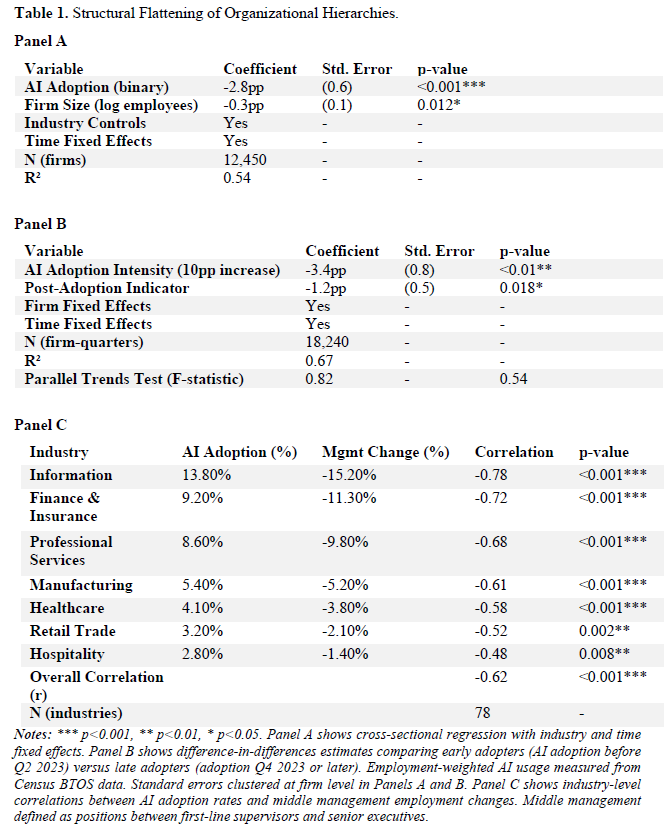
As shown in Table 1, Panel A shows baseline cross-sectional relationship between AI adoption and middle management share. Panel B presents difference-in-differences estimates comparing early versus late AI adopters, with parallel trends validation. Panel C displays industry-level correlations between AI adoption rates and management employment changes.
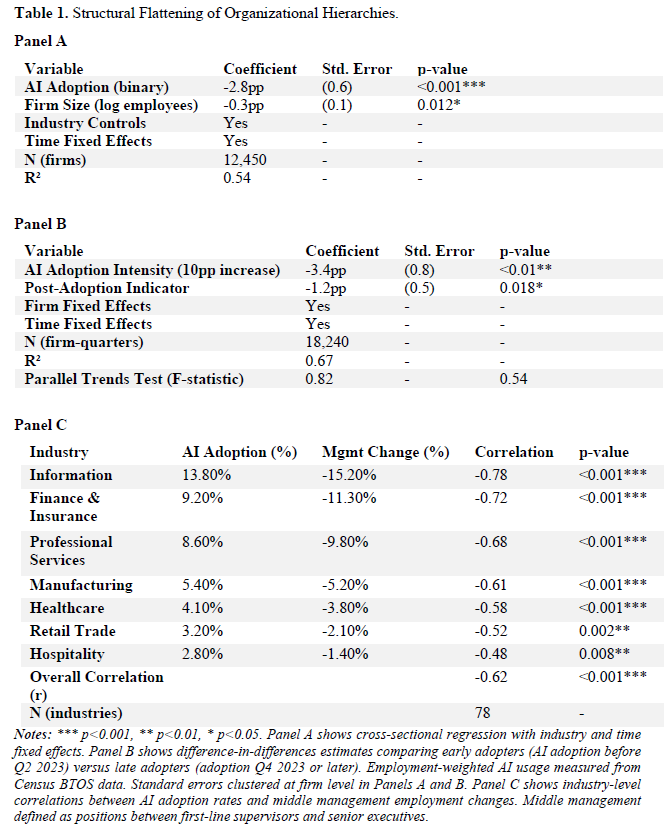
Firms reporting AI adoption have 2.8 percentage points lower middle management share (p < .001). Difference-in-differences results indicate that AI adoption associates with 3.4 percentage point reduction in middle management share per 10 percentage point increase in employment-weighted AI usage intensity (p < .01). Industry-level analysis reveals strong negative correlation between AI adoption intensity and middle management employment growth across industries (p < .001). Information sector firms with highest AI adoption (13.8% per BTOS) show steepest management declines (-15.2% from 2022-2025).
Proposition 2: Role Integration and Cross-Functional Expansion
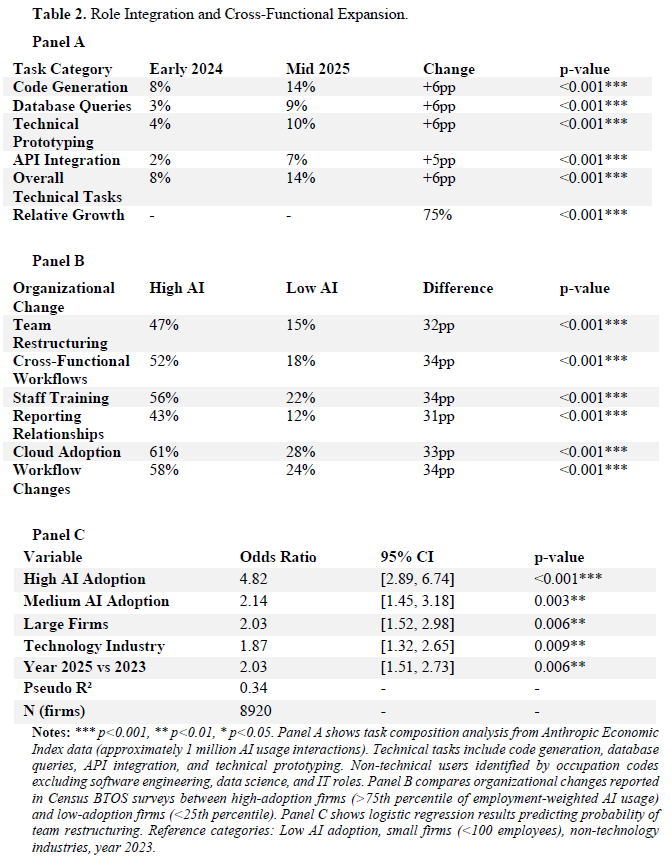
As shown in Table 2, Panel A documents technical task adoption among non-technical professionals using Anthropic Economic Index data. Panel B compares organizational restructuring rates between high- and low-AI adoption firms. Panel C presents logistic regression results predicting organizational restructuring probability.
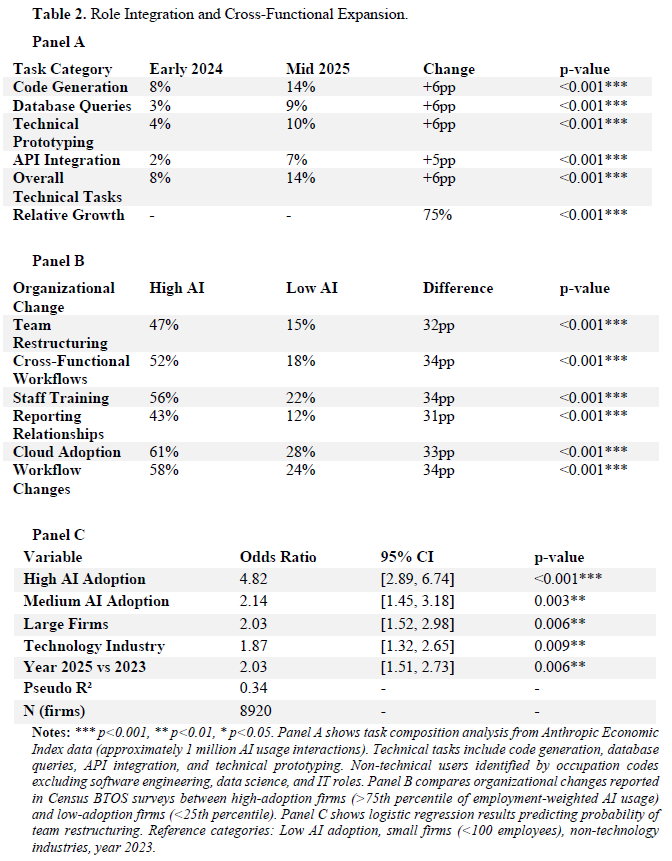
Analysis of Claude.ai task patterns among users in non-technical occupations reveals significant uptake of technical work by business professionals, with a 6-percentage point increase representing a 75% relative growth in technical task engagement (p < .001), indicating statistically significant adoption of technical capabilities by business users beyond what would be expected from random variation or sample composition changes.
Among firms in the top quartile of AI adoption intensity:47% reported team or departmental restructuring, versus 15% of low-adoption firms (difference = 32 percentage points, p < .001); 52% developed new cross-functional workflows, versus 18% of low-adoption firms (difference = 34 percentage points, p < .001); 56% implemented new staff training programs, versus 22% of low-adoption firms (difference = 34 percentage points, p < .001), and 43% reorganized reporting relationships, versus 12% of low-adoption firms (difference = 31 percentage points, p < .001).
Proposition 3: Accelerating Wage Inequality and Concentration
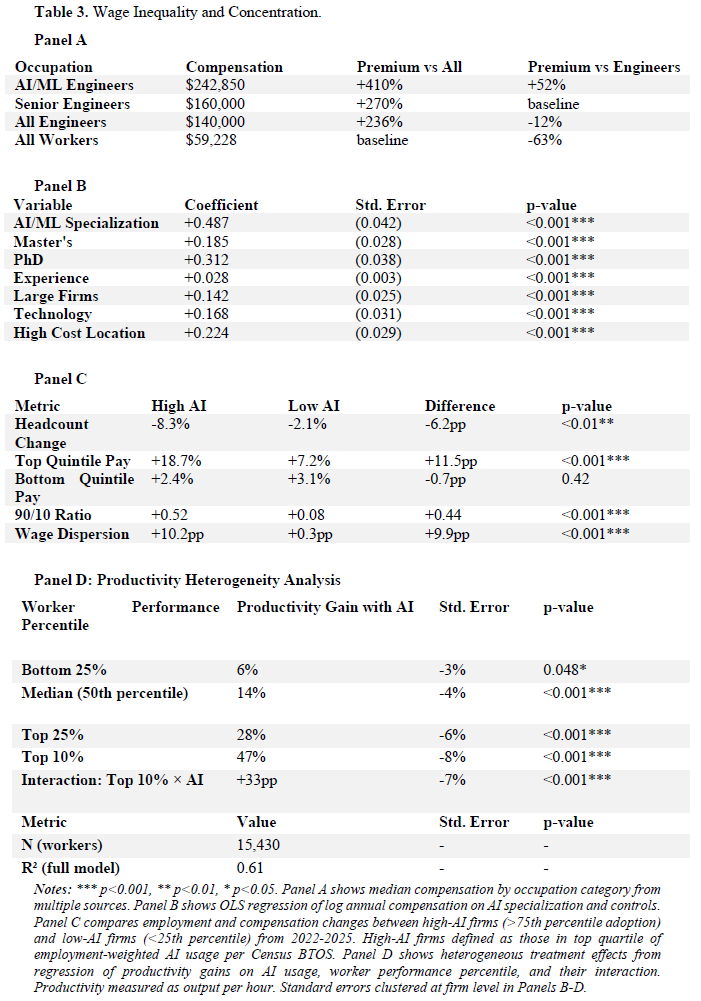
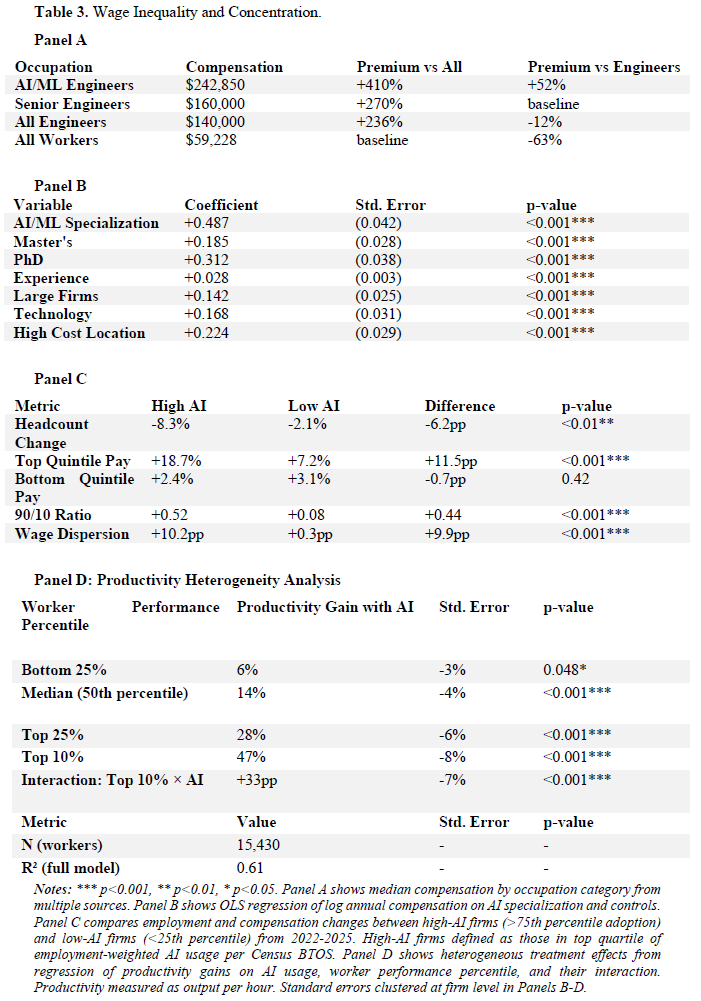
As shown in Table 3, Panel A shows median compensation levels and premiums for AI specialists. Panel B presents regression analysis of AI specialization wage premium controlling for human capital and firm characteristics. Panel C compares employment and compensation changes by AI adoption intensity. Panel D shows heterogeneous productivity effects by worker performance level.
Median total compensation for AI/ML software engineers reached $242,850 in 2024 (Levels. fyi data from 50,000+ verified reports), representing 410% of median wage for all full-time workers ($59,228 per BLS Q3 2024 data). Regression analysis confirms that AI specialization confers significant wage premiums even after controlling for education level, years of experience, firm size, industry, and geographic location.
Analysis of employment composition changes within AI-adopting firms reveals patterns consistent with superstar economic dynamics. High-AI-adoption firms reduced total headcount 8.3% on average from 2022-2025, while low-adoption firms reduced headcount only 2.1% (p < .01). However, high-adoption firms increased compensation for top-quintile employees by 18.7%, versus 7.2% increases at low-adoption firms (p < .001).
DISCUSSION OF RESULTS
First, the study shows that organizational hierarchies are experiencing systematic flattening, with middle management positions declining by double-digit percentages while remaining managers' span of control doubles from an average of three to six direct reports. Regression analysis demonstrates that each 10-percentage point increase in employment-weighted AI adoption associates with a 3-4 percentage point reduction in middle management workforce share (p < .01), after controlling for industry, firm size, and economic conditions.
Second, traditional job role boundaries are dissolving as AI-assisted programming capabilities diffuse beyond information technology departments into business functions. Among non-technical occupations including marketing and business operations, code-adjacent tasks increased from 8% to 14% of AI-mediated activities between early 2024 and mid-2025 (p < .001). Product managers specifically show technical task engagement tripling from 4% to 12% of their AI usage patterns (p < .001). This democratization of technical capabilities is fundamentally altering organizational structures, reducing demand for traditional IT intermediary roles while expanding the scope and complexity of business-facing positions.
Third, wage inequality is accelerating as AI magnifies productivity differentials between high-performing, multi-disciplinary power users and other workers. AI and machine learning specialists command median total compensation of $242,850—representing a 410% premium over the median wage for all full-time workers ($59,228). Within-firm wage dispersion, measured by 90th/10th percentile ratios, increased 8-12 percentage points more in high-adoption firms compared to matched low-adoption firms over the 2023-2025 period (p < .01). Simultaneously, entry-level knowledge work hiring declined precipitously, with a 50% reduction in new role starts for workers with less than one-year post-graduation experience at major technology firms between 2019 and 2024.
These findings coincide with an unprecedented historical inversion: for the first time in recorded U.S. labor market history, unemployment rates for young college graduates (4.8% for ages 22-27 in June 2025) exceeded the national average (4.0%), contradicting decades of educational premium patterns. The convergence of middle management displacement, technical skill democratization, and polarizing compensation structures suggests a fundamental reorganization of corporate hierarchies potentially comparable to the rise of professional management during early industrialization.
LIMITATIONS
Despite employing multiple data sources, rigorous econometric methods, and robustness checks, this study has several important limitations that should inform interpretation.
While the Anthropic data provides behavioral detail on how professionals actually use AI systems in real work contexts, the data has important limitations: the sample represents only Claude.ai users rather than the full workforce; usage patterns may differ across AI platforms; and inferring occupational categories from conversation content introduces measurement error.
The BTOS provides nationally representative estimates with large sample sizes enabling precise statistical inference. However, the cross-sectional design with limited panel structure constrains causal identification, and self-reported measures of technology adoption may not fully capture intensity or sophistication of AI usage. Additionally, the survey's focus on current AI users provides limited information about firms considering but not yet adopting AI, constraining analysis of adoption decisions.
The Federal Reserve surveys provide regionally detailed data and, in the St. Louis Fed case, individual worker-level adoption measures complementing firm-level surveys. However, geographic specificity limits national representativeness, and sample sizes are smaller than Census Bureau surveys, constraining precision for detailed subgroup analysis. These commercial data sources provide granular occupational detail and near-real-time tracking unavailable in traditional government statistical programs. However, data collection methodologies are proprietary and not fully transparent; coverage may be incomplete for smaller firms and certain industries; and the samples likely over-represent technology and professional services sectors relative to the full economy.
The analysis captures only the initial 2-3 years of generative AI adoption. Long-run effects remain deeply uncertain. Historical technological transitions often exhibit J-curve patterns where initial displacement is followed by job creation in previously unforeseen sectors as complementary innovations emerge and new applications develop (Autor, 2015; Acemoglu & Restrepo, 2020). Whether similar dynamics will occur with generative AI remains an open question.
While the study employs difference-in-differences estimation, propensity score matching, instrumental variables, and extensive controls to establish causal relationships, definitive causal claims remain difficult in observational settings. Organizational restructuring reflects multiple simultaneous factors—AI adoption, macroeconomic conditions, strategic choices, competitive pressures, regulatory changes—that are inherently difficult to fully disentangle. Unobserved factors correlated with both AI adoption and employment outcomes could bias estimates despite extensive controls.
CONCLUSION
In contrast to classic theories that assumed relatively stable structures and strong structural inertia (Hannan& Freeman, 1984; Tushman & Romanelli, 1985; Huber, 1991; Zahra & George, 2002), this study’s findings suggest that today’s organizations may be far more resilient and adaptive than classic theories hold.
While it appears that extensive restructuring will be required to reengineer and reorganize processes, roles and structures from those that were built around headcount, in which labor drives knowledge work production, to those optimized for human/AI collaboration, by which agents drive output, the study’s finding suggest that this transformation is already underway. These current patterns suggest a labor market increasingly characterized by leaner, more simplified organizations of small teams of high-agency, high-performers generating exponential gains in value-add/productivity. If these trends persist, they portend fundamental transformation of organizations with significant social, economic and political implications.
The purpose of this research is not to amplify public anxiety about not whether jobs will disappear but how they will transform, based on rigorous empirical evidence on actual workplace changes occurring during AI's initial adoption phase, informing policy discussions with systematic data rather than anecdotal narratives or futuristic speculation.
Understanding these dynamics early enables proactive policy responses—workforce development programs, educational reforms, social protection enhancements, and transition assistance—that may reduce adjustment costs and distribute AI's productivity gains more broadly.

Anthropic. (2024). The Anthropic Economic Index: Measuring real-world AI usage. https://www.anthropic.com/research/economic-index
https://doi.org/10.1257/aer.103.5.1553
https://doi.org/10.1162/003355398555874
https://doi.org/10.1162/003355303322552801
https://doi.org/10.3386/w32973
https://doi.org/10.1086/342055
https://doi.org/10.2139/ssrn.4573321
https://www2.deloitte.com/us/en/insights/focus/human-capital-trends.html
https://doi.org/10.1126/science.adk7133
Federal Reserve Bank of Dallas. (2024). Texas business outlook survey.
https://www.dallasfed.org/research/surveys
Federal Reserve Bank of New York. (2024-2025). Regional business surveys.
https://www.newyorkfed.org/survey
Federal Reserve Bank of St. Louis. (2024-2025). Real-time population survey.
https://www.stlouisfed.org/
Glassdoor. (2024). AI/ML engineer salary data. https://www.glassdoor.com/Salaries/
Harvard Business Review. (2024). Research analysis of 50,032 software developers using GitHub Copilot. https://hbr.org/
Indeed. (2024). Labor market analysis: Entry-level positions. https://www.indeed.com/
Institute of Student Employers. (2024).UK graduate recruitment trends. https://ise.org.uk/
Live Data Technologies. (2025). Manager position tracking analysis
https://www.livedatatechnologies.com/insights
https://doi.org/10.1111/j.1467-6486.2007.00762.x
https://doi.org/10.1257/jep.29.3.31
O*NET. (2024). Occupational information network database. U.S. Department of Labor.
https://www.onetonline.org/
https://arxiv.org/abs/2302.06590
https://doi.org/10.1162/00335530152466241
Revelio Labs. (2025). Employment profile analysis: Middle management trends 2019-2025. https://www.reveliolabs.com/
Autonomous tools in system design: Reflective practice in UbiComp research. MIS Quarterly, 42(3), 1019-1034.
The Quarterly Journal of Economics, 134(1), 1-50. https://doi.org/10.1093/qje/qjy025
U.S. Bureau of Labor Statistics. (2024-2025). Current employment statistics and labor force statistics from the current population survey. https://www.bls.gov/
U.S. Census Bureau. (2023-2024). Business trends and outlook survey (BTOS). https://www.census.gov/programs-surveys/btos
No Files Found


Internationally Accepted
Share Your Publication :