
-
Publish Your Research/Review Articles in our High Quality Journal for just USD $99*+Taxes( *T&C Apply)
Offer Ends On
Publish Your Research/Review Articles in our High Quality Journal for just USD $99*+Taxes( *T&C Apply)
Offer Ends On
Philip L Millstein DMD, MS*
Corresponding Author: Philip L Millstein, Department of Restorative Dentistry, Harvard School of Dental Medicine, Boston, Massachusetts, USA.
Received: November 05, 2026 ; Revised: November 09, 2026 ; Accepted: November 10, 2026 ; Available Online: November 13, 2026
Citation: Millstein PL. (2026) Trigeminal Neuralgia is Neural; It’s Trigger Zones May Be Oral. J Oral Health Dent Res, 5(3): 1-2.
Copyrights: ©2026 Millstein PL. This is an open-access article distributed under the terms of the Creative Commons Attribution License, which permits unrestricted use, distribution, and reproduction in any medium, provided the original author and source are credited.
Views & Citations
Likes & Shares
Trigeminal neuralgia is a disease of unknown origin. There is no cure other than surgery. Episodes are often initiated through facial, oral or intra oral trigger zones. Occlusion is never addressed but could it be a precipitant?
Key words: Occlusal dysfunction, Chewing, Grinding. Condylar disarticulation.
Trigeminal neuralgia is a deadly disease of unknown origin [1]. It occurs spontaneously and there is no warning [2] There is no cure. Surgery on the ganglionic nucleus using a knife or needle is often the only way to stop the mandibular spasms and ensuing pain [3]. A neurologist or neurosurgeon treats the disease. Since it manifests itself both intra and extra orally it often falls within the dentist’s acumen to help decide the diagnosis. A neurosurgeon can not rationally examine an occlusion. An oral surgeon as well as a general practitioner are also limited because they can not evaluate what they can not see. There are no records. They are not trained to examine occlusal contact records of the static and functioning dental occlusion. Nor can they compare occlusal records. There are 3 branches of the trigeminal nerve radiating from the nucleus [4]. The mandibular branch innervates the inner and outer surfaces of the mandible. The middle branch affects the maxilla and the upper branch often crosses with the third cranial nerve. Upon seizure pain follows numbness along with severe pulsations [5].
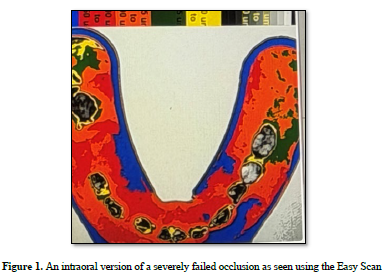
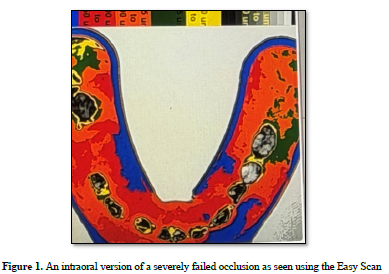
Could a minimal or severe dental occlusal imbalance precipitate sporadic incidents or create an environment susceptible to attacks? [6] Episodic pain and spasm is usually directed towards one side of the face. Since the nucleus is so close to the TMJ could an aberrant condylar movement precipitate an incident? The joint area is suffused with a micro vasculature of nerves and blood vessels but the joint per se is avascular. It is assumed that if a small vessel rubs against a demyelinated nerve that a seizure may follow. If a dental occlusion is uneven it’s function will affect the condyles thousands of times daily. The condyles may become. permanently damaged. Damage does not need to be the same for each condyle and damage does not presuppose neuralgia. There is no end to static and functional occlusal disharmony because a malocclusion remains as seen on the Easy Scan (Figure 1).
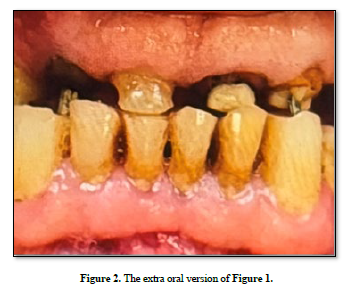
Black, grey and whitish areas represent intense occlusal grinding. An uneven bite creates uneven patterns of closure accompanied by tooth destruction [7] (Figure 2).
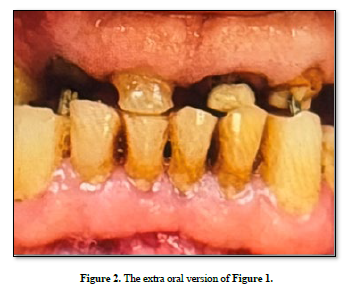
Do bruxers suffer bouts of neuralgia? Is clenching related to uneven shaped condyles? Who are the most susceptible? Clinical occlusal research is minimal. Research as to occlusal contact is non existent. Most occlusal research is non clinical. Animal models suffice. To minimize or avoid a disease it is best to practice prevention. Is the bite even? Is it balanced? Did the clinician prescribe a personalized form/fit bite guard? Assumptions are made but it is difficult to assess whether trigeminal neuralgia could be associated with the occlusion when there are no descriptions of trigger zones or permanent records of the occlusion. The oral cavity as an incubator remains open to further clinical research. A balanced occlusion always helps. Prevention is suggested.

No Files Found


Internationally Accepted
Share Your Publication :