
-
Publish Your Research/Review Articles in our High Quality Journal for just USD $99*+Taxes( *T&C Apply)
Offer Ends On
Publish Your Research/Review Articles in our High Quality Journal for just USD $99*+Taxes( *T&C Apply)
Offer Ends On
Philip L Millstein DMD, MS*
Corresponding Author: Philip L Millstein, Department of Restorative Dentistry, Harvard School of Dental Medicine, Boston, Massachusetts, USA.
Received: October 20, 2026 ; Revised: October 23, 2026 ; Accepted: October 25, 2026 ; Available Online: October 26, 2026
Citation: Millstein PL. (2026) An Occlusion Can Be Irreversibly Damaged by Using Occlusal Contact Indicators. J Oral Health Dent Res, 5(3): 1-3.
Copyrights: ©2026 Millstein PL. This is an open-access article distributed under the terms of the Creative Commons Attribution License, which permits unrestricted use, distribution, and reproduction in any medium, provided the original author and source are credited.
Views & Citations
Likes & Shares
The improper usage of occlusal contact indicators can result in destructive tooth reductions. New tooth additions are not possible. The positive and negative effects of indicator markings and their interpretations must be addressed.
Keywords: Indicators, Contact, Force, Intensity.
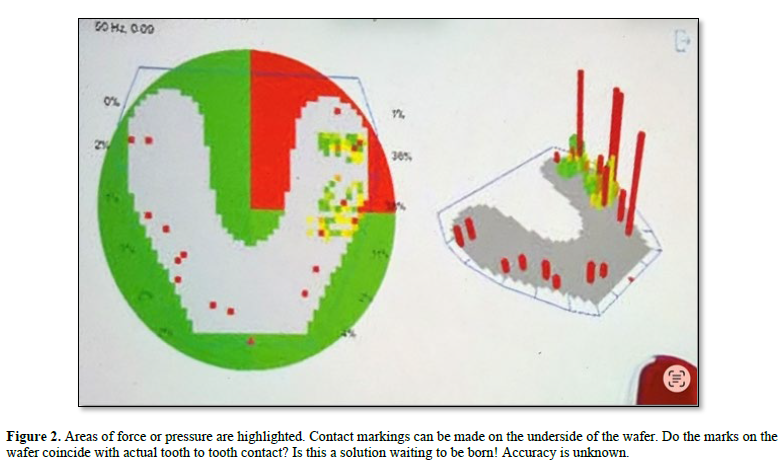
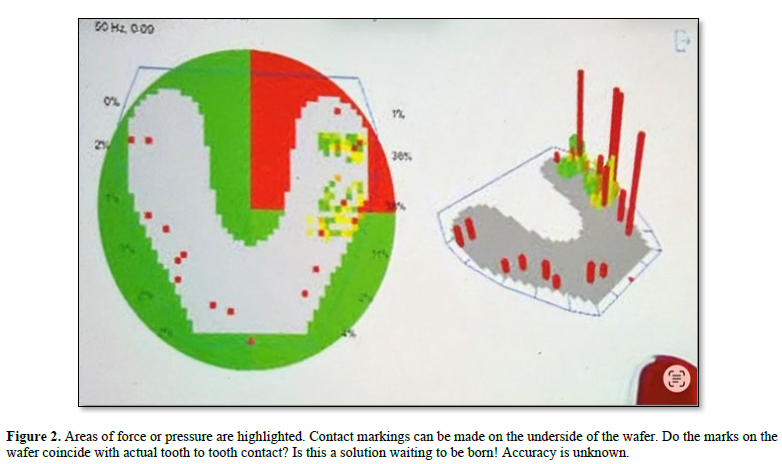
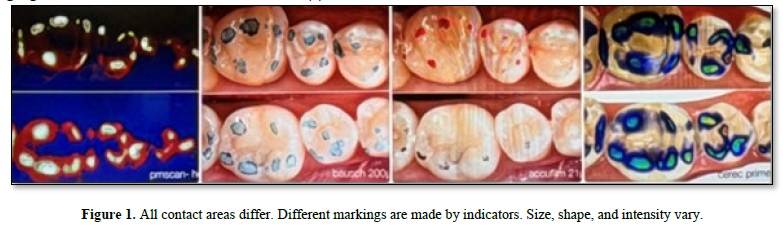
Dentistry was formally established in 1867. Vulcanite rubber was used as the base material for dentures. Crude porcelain teeth were inserted for function and appearance. Function was minimal. Manual typewriters were introduced. The denture occlusion was monitored using typewriter ribbon and carbon paper (1). Commercial marketing of paper and ribbon followed. Not much has changed. Electronic devices may be employed to record occlusal contact forces however marking indicators are still required. Indicated accuracy is unknown (2). Twenty eight gauge indicator wax is used to measure contact (3). A black wax pencil is used to mark exposed areas of teeth that perforate the green wax. Wax markings are not precise and they are often incomplete. There are no standards. Dentists use millions of indicators. They are disposable. The cost is minimal to the dentist compared to the profits reaped by the manufacturer. No clinician or dental testing organization questions indicator accuracy or reliability (4). All indicators make contact but the results differ [Figure 1]. Marking systems bleed ink upon contact. The electronic systems measure force [Figure 2].
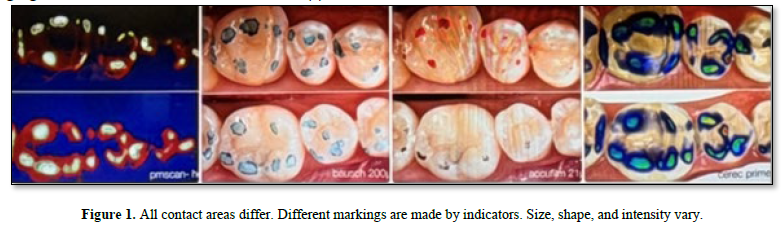
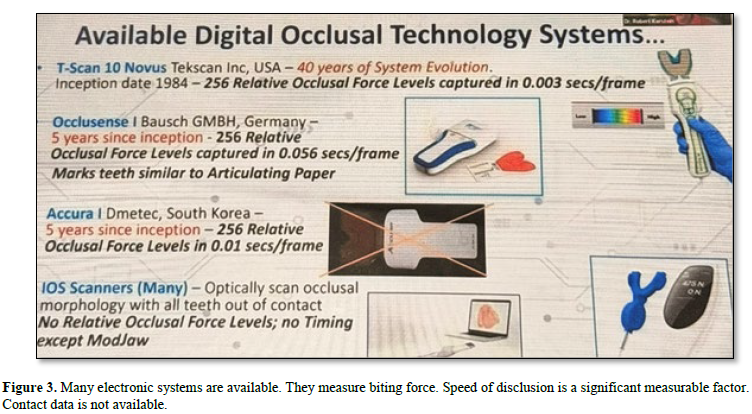
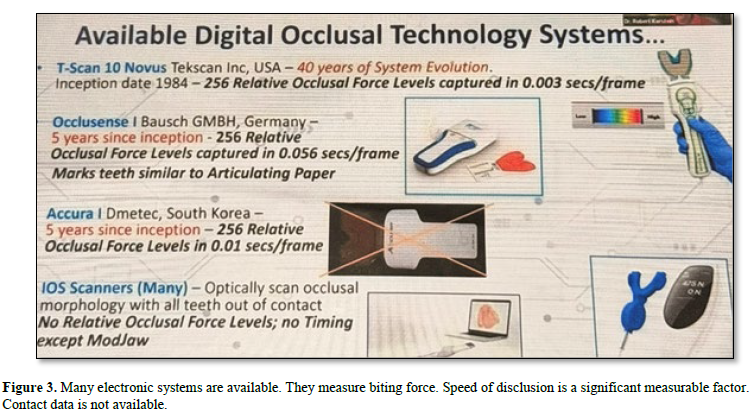
The pressed indicator wax attempts to display contact intensity. Knowledgeable clinicians know what they use and use what they know. They know their indicators. Some clinicians choose force indicating systems that do not mark? [Figure 3]. Is a force measuring system necessary or can contacts be recorded in simple fashion with a contact indicator? How much unnecessary tooth structure is removed in an attempt to balance a bite on a wafer using force measuring wafers? An alternative means is to make visual comparisons of indicated
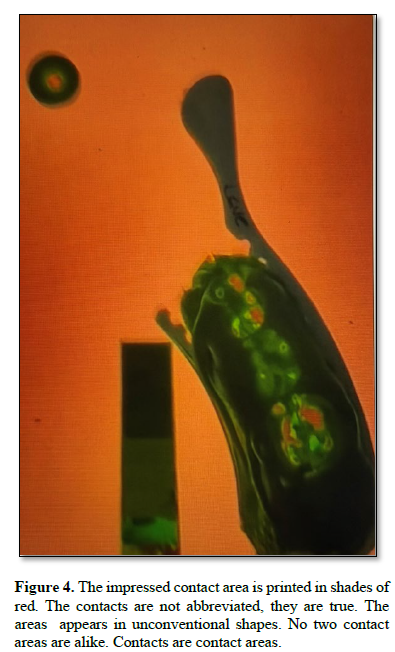
tooth contact using a novel contact indicator (5). This requires taking a silicone impression of an occlusal contact. The contact surface does not distort. An indicator can damage a contact marking upon impact.
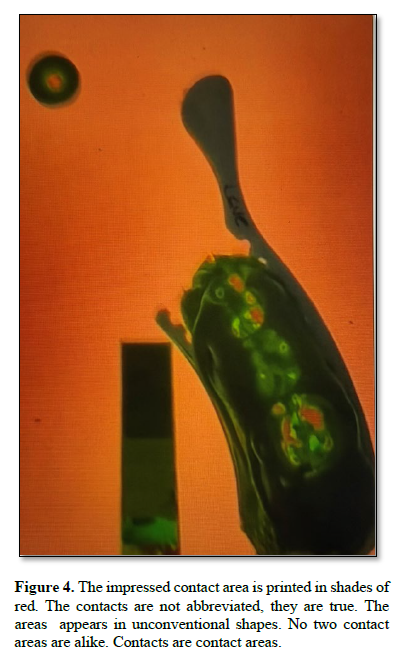
Contact areas can be highlighted using the Easy Scan with image analysis. The total procedure takes a minute. The exact size and location of the contact areas is shown in red. Contact areas are not conventional [Figure 4]. Intensity of contact is readable.
Misreading contact markings and force renderings in daily dental practice is common. Removing essential tooth structure occurs. The damage goes unnoticed. The clinician remains unaware. Occlusal equilibration is a common dental procedure. Insurance pays. Manufacturers sell a disposable item (6). Electronic systems with wafers are expensive and may not provide an improvement over existing methods. Without a testing standard there is no way to compare and evaluate measuring systems. Every occlusal contact is unique (7). No two are the same. Marking indicators tend to make contacts appear conventional. Contacts appear uniform (8). Schools teach ideal occlusal contact anatomy. Contact recognition is a strong factor in choosing an indicator. Clinical success is dependent on marking interpretations. Who is to judge a true contact when there are no standards? A viable occlusion depends upon strong occlusal contact (9). Removing contacts threatens occlusal stability. How many implant reconstructions are the product of occlusal instability and a failed occlusion. Class room instruction on the choice and application of occlusal contact media could be instituted in the dental curriculum. Contact indicating is a significant part of clinical dentistry. It should be included under the discipline of preventive dentistry.

No Files Found


Internationally Accepted
Share Your Publication :