
-
Publish Your Research/Review Articles in our High Quality Journal for just USD $99*+Taxes( *T&C Apply)
Offer Ends On
Publish Your Research/Review Articles in our High Quality Journal for just USD $99*+Taxes( *T&C Apply)
Offer Ends On
Philip L Millstein DMD, MS*
Corresponding Author: Philip L Millstein, Department of Restorative Dentistry, Harvard School of Dental Medicine, Boston, Massachusetts, USA.
Received: September 27, 2026 ; Revised: September 30, 2026 ; Accepted: October 01, 2026 ; Available Online: October 02, 2026
Citation: Millstein PL. (2026) Centric Relation is Enigmatic. J Oral Health Dent Res, 5(3): 1-2.
Copyrights: ©2026 Millstein PL. This is an open-access article distributed under the terms of the Creative Commons Attribution License, which permits unrestricted use, distribution, and reproduction in any medium, provided the original author and source are credited.
Views & Citations
Likes & Shares
Centric relation is a posterior superior position of the condyles to the joint processes. Centric occlusion is where the teeth meet in occlusion. Centric relation is an open spatial position whereas centric occlusion is a forward closed position. The teeth meet in centric occlusion.
Keywords: Centric occlusion, Centric relation, Occlusion, Articulation.
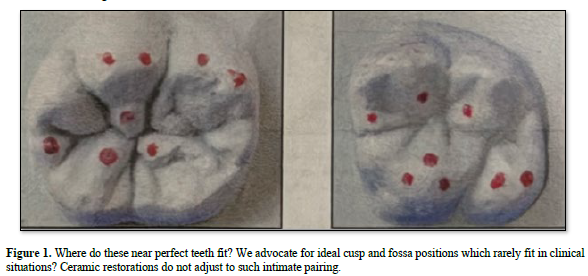
Centric relation is a repeatable starting point for restoring dentitions [1]. Cusps and fossae of teeth are designed to fit into one another (Figure 1) [2]. Centric relation records of condylar positions take much time and expertise to develop [3]. Three dimensional articulators accept centric relation records.
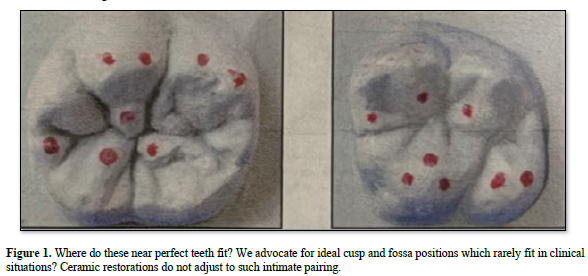
In the far past restorative dentistry was performed using low speed hand pieces. Drilling was laborious. Restorative cases were done one at a time. The dentist often did the laboratory work. Carving waxes were developed for specific waxing procedures [4]. Occlusal oriented waxed crowns were invested and cast into gold [5]. The occlusion was built on the cusp fossa principle. The cusp fit into the fossa in the centric relation position. Today we use porcelain which cannot replicate the fine points of wax [6]. Cusp to fossa fit is not as specific as with cast gold. Stamp cusps are often used to make occlusal contact. When a completed full mouth restoration does not fit or almost fits into a patient’s occlusal scheme then what is the outcome? Everything looks good on the articulator but the questions arise as to whether the centric relation records were accurate and the transfer to the articulator was precise? There are no occlusal records. Successful restorations are measured by clinical longevity. In all of the commercially driven classes on occlusion students are taught how to find and “capture” centric relation [7]. Attendees pay to play. Commercial courses cost time and money. Participants buy everything and anything to “capture” centric relation [8]. However capturing centric relation may not work the same way in clinical practice. Ceramics don’t break and implants can become loose.
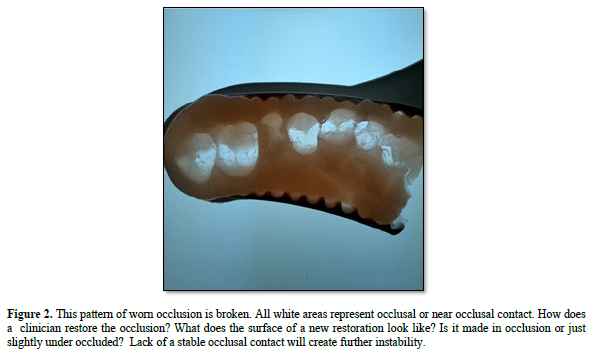
Teeth can move, jaws can hurt and a general malaise can develop. Without any occlusal records the proof of recording a proper centric relation becomes a conversational topic. Dentists should rethink of how they record jaw positions before sending the records to the dental laboratory. No laboratory can afford repairs and remakes. Dentists do not keep occlusal records. They wait for things to break (Figure 2).
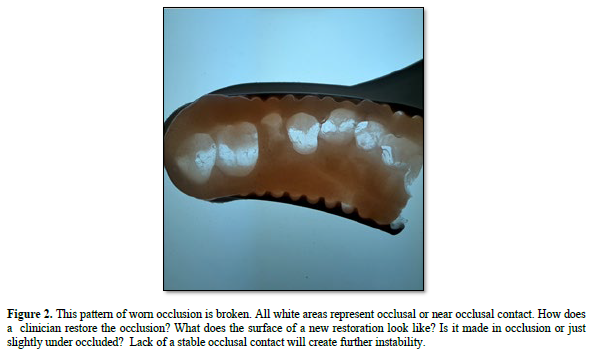 Does TMJ pain ensue or does facial pain develop? To make a centric relation record in fifteen minutes time is not possible because the joint is worn and the cartilage damaged. Often times we cannot take a precise bite. An alternative procedure may be used to restore the vertical dimension and then take a bite followed by a functionally generated path procedure [9]. Most rules for occlusal restoration were written many years ago for the edentulous patient. Today there are dentulous patients but we still apply the same rules. Basically there is little clinical research on occlusal function. The effects of trauma from the occlusion are mentioned but not explored. There are no occlusal records to compare past to present. Force and pressure recordings do not record occlusal contact [10]. Comparisons of occlusal records over time are essential for a better understanding of the occlusal dynamic. Without new information we will continue to follow in the footsteps of yesteryear.

No Files Found


Internationally Accepted
Share Your Publication :